What is Answer Engine Optimization?
AEO is the practice of structuring your content so AI-powered search tools — Google AI Overviews, ChatGPT, Perplexity, voice assistants — can understand it, trust it, and cite it as a direct answer.
Think of it this way: traditional SEO gets you on the results page. AEO gets your content into the answer itself.
The two are complementary. Good SEO is still the foundation — you need rankings, backlinks, and technical health. AEO adds the layer needed for AI visibility. You need both.
We have been doing SEO for over 9 years at Rezult. AEO is not replacing what we do — it is expanding it. And the businesses that adopt it early are seeing real advantages.
What are Google AI Overviews?
AI Overviews (formerly called SGE — Search Generative Experience) are AI-generated summary boxes that appear at the top of Google search results. Powered by Google's Gemini 2.0, they pull from multiple websites, synthesise the information, and provide a direct answer with citation links.
Here is what you need to know about how they work:
- They use Retrieval-Augmented Generation (RAG) — pulling from both pre-trained AI data and real-time web content
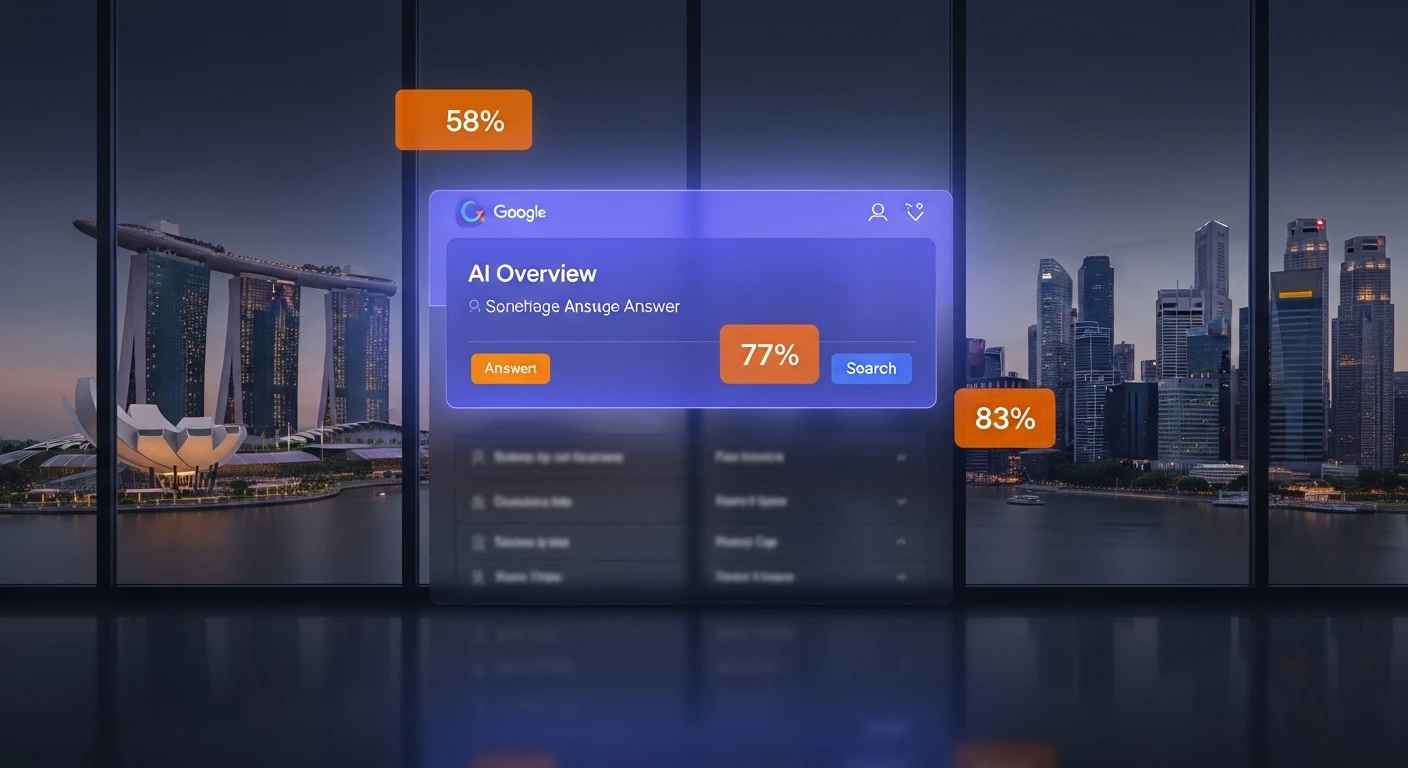
- They now appear in 50-60% of all Google searches — and growing every month
- When AI Overviews appear, the zero-click rate hits 83%
- But brands cited in AI Overviews gain 35% more organic clicks than uncited competitors
The paradox: AI Overviews reduce total clicks, but the clicks that do happen go disproportionately to the cited sources. Being the source AI trusts is the new ranking #1.
AEO vs traditional SEO — what changes?
Notice the last row. Traditional SEO relies heavily on domain authority — how many quality backlinks point to your site. For AI Overviews, the strongest correlation is semantic completeness (r=0.87) — how thoroughly your content covers a topic. A smaller website with comprehensive, well-structured content can outperform a big brand with better backlinks.
This is good news for Singapore SMBs. You do not need to outspend Enterprise competitors on backlinks. You need to out-structure them on content.
What are answer capsules?
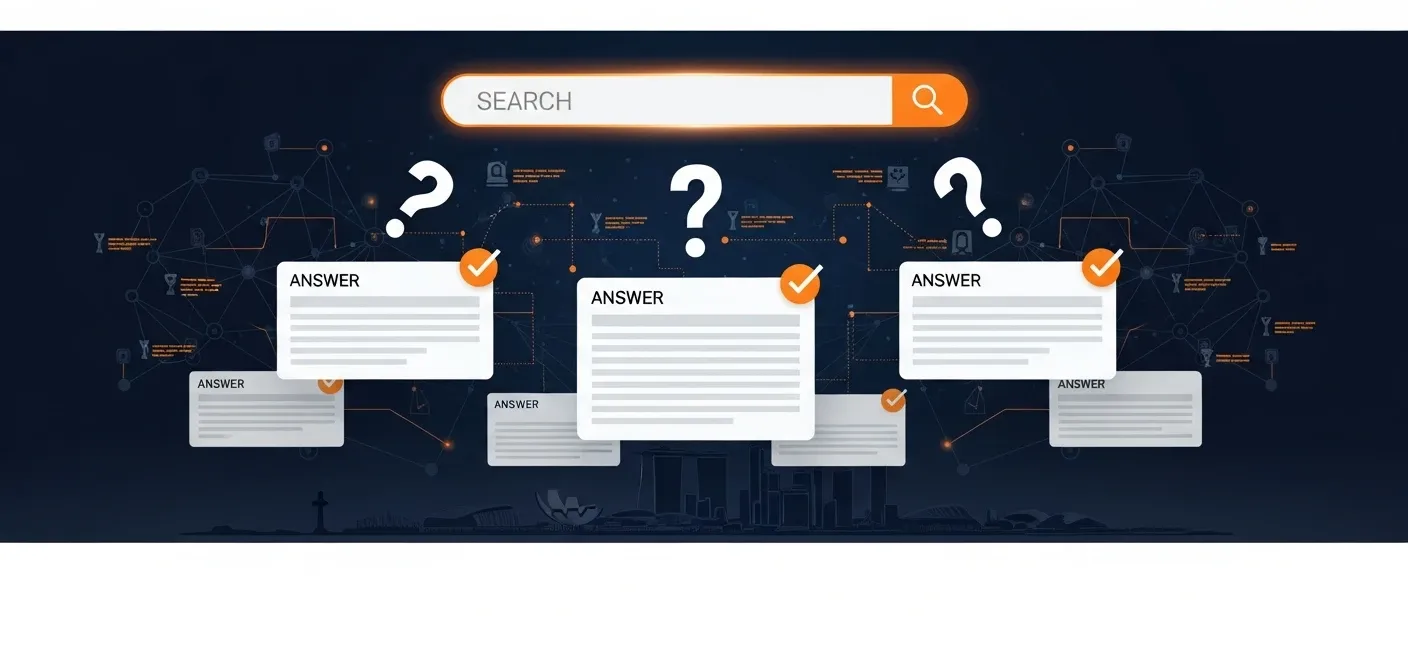
An answer capsule is a self-contained block of content that directly answers a specific question. It makes sense on its own — without needing surrounding context. This is exactly what AI extracts and displays in overviews.
Here is the formula based on analysis of 15,847 AI Overview results:
Use the exact question your customer would ask. "What does SEO cost in Singapore?" not "Our SEO Pricing Structure."
Answer the question immediately. No preamble, no "great question!" — just the answer. This is what AI extracts first.
Expand with specifics, examples, data. The full section should be 134-167 words — the sweet spot for AI extraction. 62% of featured content falls between 100-300 words per section.
Include 15-20 recognised entities per 1,000 words — specific names, places, brands, tools, standards. Pages with high entity density are 4.8x more likely to be selected for AI Overviews.
This article you are reading right now is structured as answer capsules. Every H2 is a question. Every section opens with a direct answer. Then we expand. This is what we do for our clients' content too.
Schema markup — the technical foundation
Schema markup is structured data you add to your website's code that tells AI exactly what your content means. It is the difference between AI guessing what your page is about and AI knowing precisely.
Pages with schema markup are 2.8x more likely to be cited by AI engines (AirOps research). Pages with FAQPage schema achieve a 41% citation rate versus 15% without.
Here are the schema types that matter most for Singapore SMBs:
FAQPage
Maps directly to how people query AI. Highest AEO impact. Add this to every service page and blog post with Q&A content.
Impact: Very HighLocalBusiness
Critical for Singapore location-based searches and voice queries. Includes your address, phone, hours, service area, and reviews.
Impact: Very High (local)Article / BlogPosting
Tells AI who wrote it, when, and what it covers. Required for any blog post targeting AI citations. Supports E-E-A-T signals.
Impact: HighHowTo
For step-by-step processes AI can extract and display. Google can show these as rich results with numbered steps.
Impact: HighProduct / Review
For e-commerce. Shows prices, availability, and ratings directly in search. Critical for commercial queries.
Impact: High (e-commerce)Service
Describes what services your business offers, pricing ranges, and service areas. Helps AI match your business to relevant queries.
Impact: Medium-HighOn static sites built with Astro, schema markup is baked into the template — clean, consistent, no plugin conflicts. On WordPress, you need plugins like Yoast or RankMath, which can conflict with other plugins and slow your site.
Practical steps — how to make your content AEO-ready
Here is the checklist we follow for every client at Rezult. You can apply this to your own content today:
Content structure
- Start every section with a direct answer — 50-70 words that stand alone
- Use question-based headings — match how people actually search
- Keep sections at 134-167 words — the AI extraction sweet spot
- Use lists and tables — 32% of AI citations come from listicle-format content
- Include the current year in titles and descriptions — freshness matters, 23% of AI-featured content is less than 30 days old
Technical implementation
- Add FAQPage schema to every service page and FAQ section
- Add LocalBusiness schema to your homepage and contact page
- Add Article schema to every blog post
- Build a fast website — AI crawlers favour fast-loading pages with clean HTML. Astro sites output pure HTML that any crawler can read instantly
- Ensure mobile-first — 97% of Singaporeans are on smartphones
Authority building
- Build presence where AI cites — Reddit (21-47%), YouTube (13-19%), Quora (14%)
- E-E-A-T signals — author bios, credentials, real experience. 96% of AI Overview content comes from verified authoritative sources
- Multi-modal content — combine text + images + video + schema. Pages with multi-modal content see 156% higher AI selection rates
- External citations — link to authoritative sources. Content with specific citations shows 89% higher AI selection probability
Why this is urgent for Singapore
Singapore is one of the most digitally advanced markets in the world. According to DataReportal and IMDA:
Your competitors are catching on. The businesses that structure their content for AI extraction now will dominate the answer layer for years. The ones that wait will have to fight harder to catch up — just like the businesses that ignored mobile-first indexing in 2019.
The government's Productivity Solutions Grant (PSG) subsidises up to 50% of digital tools including AI-enabled marketing solutions. There has never been a better time to invest in AEO-ready infrastructure.
The bottom line
SEO is not dead. But SEO alone is not enough anymore. AEO is the layer that gets your business into AI answers — the place where most users now find information.
Structure your content as answer capsules. Add schema markup. Build a fast website that crawlers love. Create content with real expertise and authority. These are not radical changes — they are the natural evolution of good SEO practice.
The question is not whether AI search will change your business. It already has. The question is whether you are the answer — or the one being replaced by it.
Is your content AEO-ready?
We audit your website for AI visibility — schema markup, content structure, page speed, answer capsule readiness, and E-E-A-T signals. Free, no obligation. We will tell you exactly what needs fixing.
Get Free AEO Audit