
Short answer: a tuition agency management system should close the daily money loop first: lesson done, invoice built from it, parent pays by PayNow or card, tutor payout calculated and approved. Special Minds, a special-needs tuition agency in Singapore, replaced a legacy admin, Google Sheets and WhatsApp chasing with one progressive web app built in three phases. These are the five decisions that made it work.
Where it started
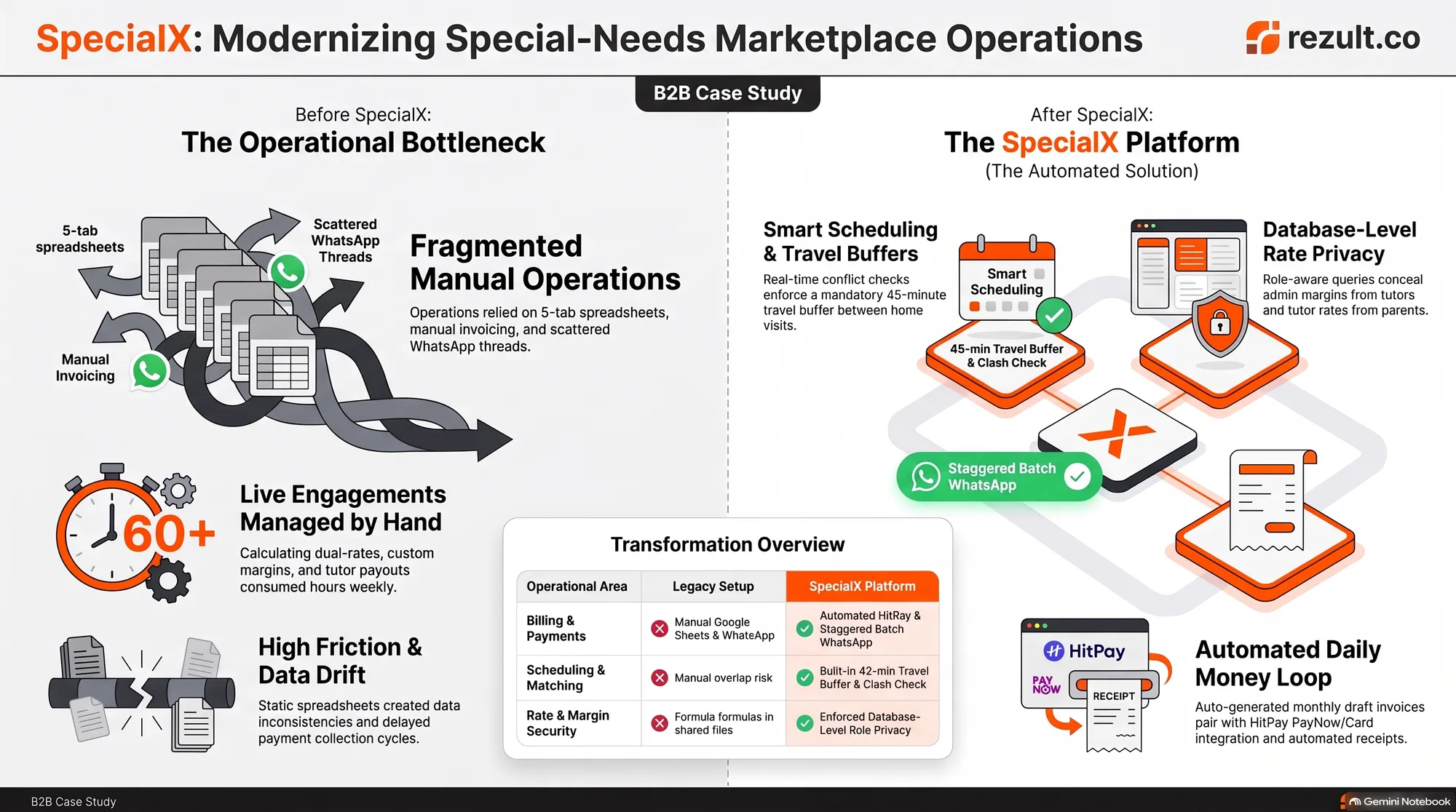
Special Minds matches families with professional tutors and therapists for children with special educational needs, mostly one-to-one at home. When we started, the operation lived in a legacy admin, parallel spreadsheets, and WhatsApp and Telegram threads. Matching, confirming sessions, billing parents and paying tutors took dozens of admin hours a month, mostly chasing and reconciling by hand. The platform we built for them is called SpecialX.
We set one rule above everything else: do not build feature noise, close the daily money loop.
1. Scope phase 1 by finding the side spreadsheet
Every business running on old software keeps a side file where the real work happens. Watch the admin work for an hour and you find it: payouts worked out by hand, overdue invoices chased one by one, who is matched with whom. That file is the roadmap.
Phase 1 was eight pieces and nothing else: three roles with one-time-code login, the assignment as the central record (parent, tutor, child, rates), lesson records, invoices generated from lessons, PayNow QR and card payment links, calculated tutor payouts, an audit log of every change, and privacy enforced in the database. Every piece either moves money, records money or protects money.
2. Privacy belongs in the database query, not the screen
Hiding numbers with screen tricks is a leak waiting to happen: whatever is fetched can be seen. So each role's data is cut in the query itself. Parents see their own rate. Tutors see their own pay. Admin sees everything. A tutor's screen cannot leak a number that was never sent to it.
3. Net prepaid credits on the invoice, never after
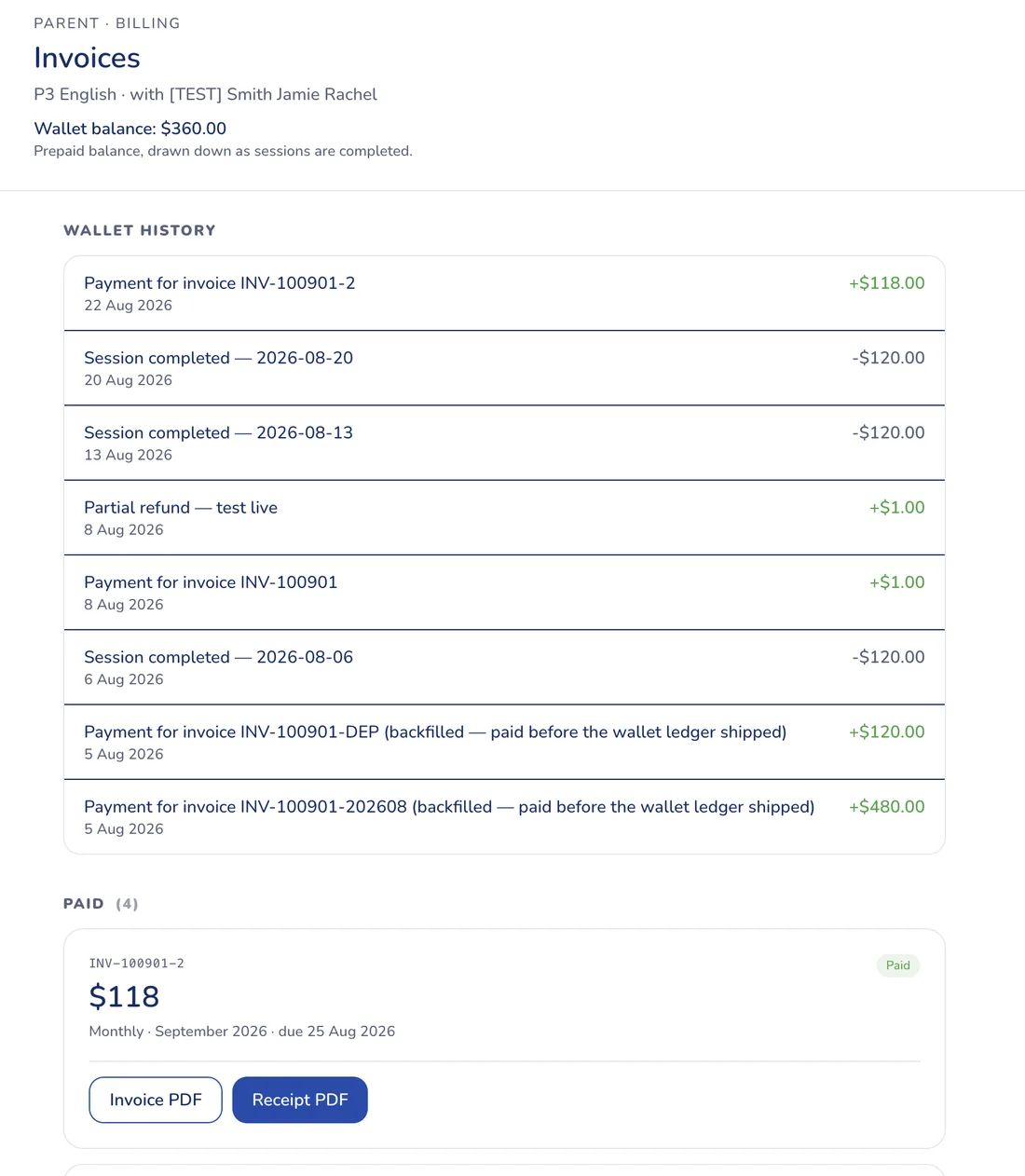
Billing variable schedules against prepaid balances is where overcharges happen, and one overcharge costs more trust than ten smooth months build. The app nets any prepaid credit on the invoice line items before the parent is asked to pay. Credit never goes below zero, cancellations release reserved credit instantly, and two runs can never touch the same balance at the same time.
4. Test billing on the real system, safely
A copy of the database is never quite the real thing, so billing bugs hide until they meet real money. We tested on the live platform behind two switches: payments in sandbox mode until go-live, and every billing email and message held to an allowlist of admin inboxes. Before each monthly run, admin can export a dry run of every invoice line. Check first, send second.
5. Keep a person on the money
The modern move is to pay tutors straight through a bank API. We did not, yet. Tutors see their earnings, the system calculates payouts per lesson, an admin checks the batch and exports a bank file, then marks it paid. Same for invoices: nothing goes out until someone presses send, and messages go out paced through the day. It prevents double payments and keeps the build small. Automation comes once the numbers have been right for a few months.
What changed
- Monthly invoices are generated from completed lessons and sent in one paced run over WhatsApp.
- Parents have their own login with sessions, credits, invoices and receipts.
- Tutors set availability, mark lessons done in one tap and see their own pay.
- Admin has a finance view of cash in, unpaid invoices and tutor pay to come.
The whole build ran in three paid phases plus a flat monthly running cost, so the agency saw each part working before committing to the next. That is how we price custom apps for small businesses.
FAQ
What is a tuition agency management system?
Software that runs the daily operations of a tuition agency in one place: matching tutors to students, scheduling sessions, recording attendance, invoicing parents, collecting payment and paying tutors. A good one gives parents, tutors and admin their own logins, each seeing only what they should.
Is off-the-shelf tuition centre software enough for an agency?
For a centre with fixed classes and one fee table, usually yes. Agencies with home visits, different rates per tutor, prepaid credits and per-session payouts often end up keeping a spreadsheet next to the software. That spreadsheet is the sign a custom build will pay off.
How much does a custom tuition management system cost in Singapore?
Singapore software houses usually quote SGD 20,000 to 80,000 for a platform like this. Built in phases, the first working phase can start from around SGD 2,000, with each later phase quoted after the previous one is in use, plus a flat monthly running cost.
Should tutor payouts be fully automated?
Not at first. A human-approved batch (the system calculates, an admin checks and exports a bank file) avoids double payments and keeps the build small. Direct bank APIs can come later, once the numbers have been right for a few months.
Running your business on spreadsheets and WhatsApp?
Walk us through a normal week. We come back with what phase 1 should fix, how long it takes and what it costs.
Book the Call