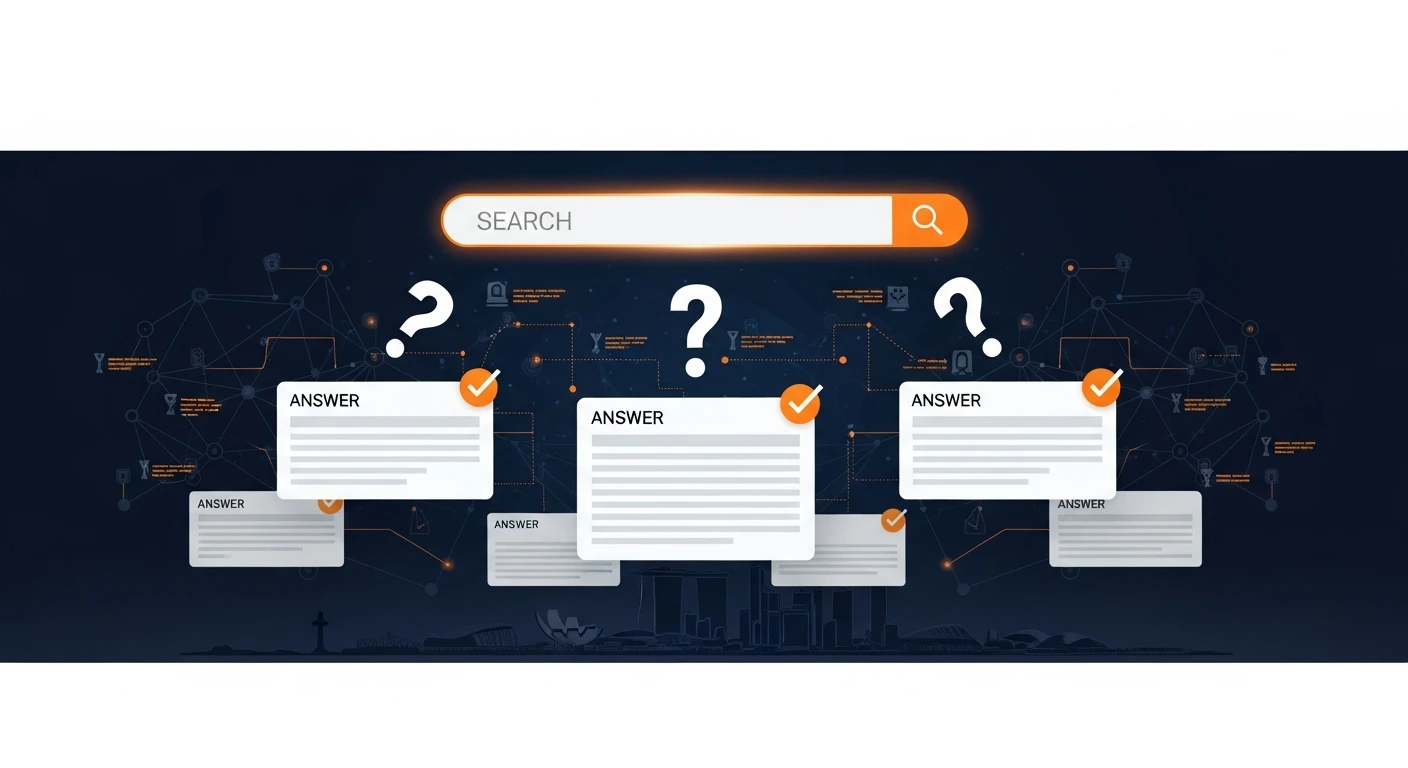
Open YouTube any day this year and somebody is announcing that SEO is dead. It is the same yearly funeral we covered in Is WordPress Dying?. Last month it was AI Overviews killing it. This month it is ChatGPT. Next month it will be something else. We have heard it so often we stopped counting.
Here is the honest version, from someone who runs SEO for Singapore businesses every week and reads the client reports when they look bad, not just when they look good. SEO is not dead. It changed shape. There are now two lanes instead of one, and the scoreboard moves every single day. The businesses that panic at every wobble make worse decisions than the ones that keep doing the right work.
Is SEO dead in 2026?
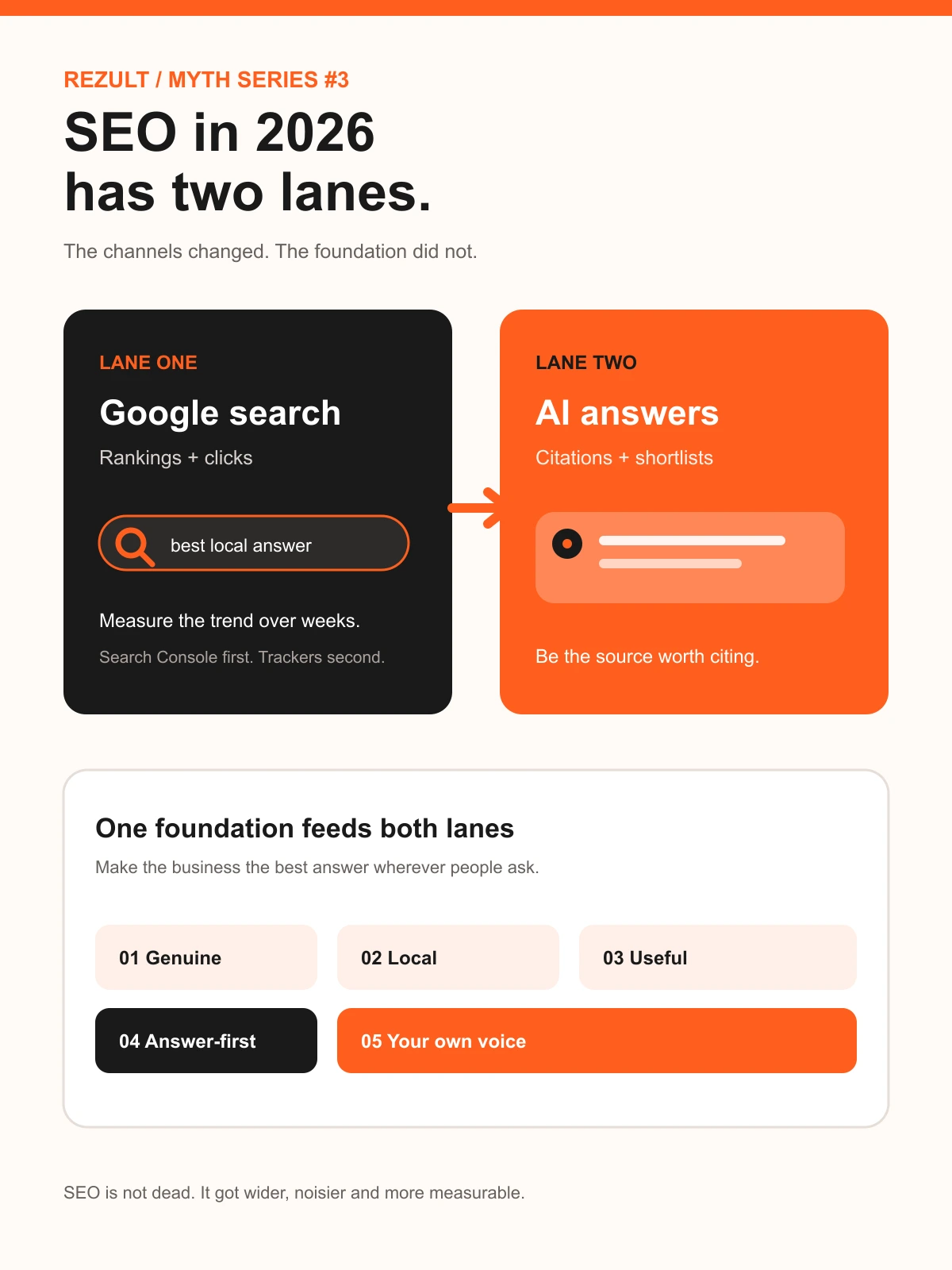
Quick Answer: No. SEO split into two lanes in 2026: classic Google rankings and AI answers (Google AI Overviews, ChatGPT, Gemini, Perplexity). Rankings are now far more volatile, a study of 8.1 million searches found 48.7% more volatility after Google’s May 2026 core update, so single-day positions mean little. What still wins both lanes is the same thing: genuine, local, useful content with a clear answer, real proof, and a business’s own voice. Businesses that stop doing SEO disappear. Businesses that keep doing it well get found in both places.
Lane one: Google still matters, it just moves every day now
In May 2026 Google rolled out a core update. Afterwards, Yext analysed 8.1 million search results and found organic ranking volatility jumped 48.7%, with 97% of tracking reports shuffling. And it never calmed back down. Joy Hawkins of Sterling Sky, who has been testing local SEO for years, put it simply: a single, static “we rank number one” is no longer a real thing. Two people searching the same phrase at the same moment can see different results.
SE Ranking’s own analysis of the same update found 88% of top-10 results changed position and roughly one in five top-10 pages fell out of the top 100 altogether.
So when a weekly ranking report shows a keyword at #4 on Monday and #22 on Friday, that is not a collapse. That is Tuesday in 2026.

We saw this live with a Singapore e-bike retailer we work with. One week their tracker showed the average position falling hard, and the client wrote in worried. Same report, read properly: visibility up 11%, the main sales keywords sitting between #3 and #5, and a keyword that was outside the top 100 the week before now at #3. The “drop” was a handful of small long-tail keywords bouncing in and out of the top 100 and dragging the average with them. Search Console told the calmer, truer story.
How we read it now: trend over weeks, not positions over days. Search Console first, rank trackers second.
Lane two: people now ask, then they decide
The second lane is the one most businesses are not even measuring. People do not follow one path to buy anymore. They ask ChatGPT for a shortlist. They see the Google AI answer. They spot you on Facebook. They read reviews. They Google your name again. Then they walk into the shop.
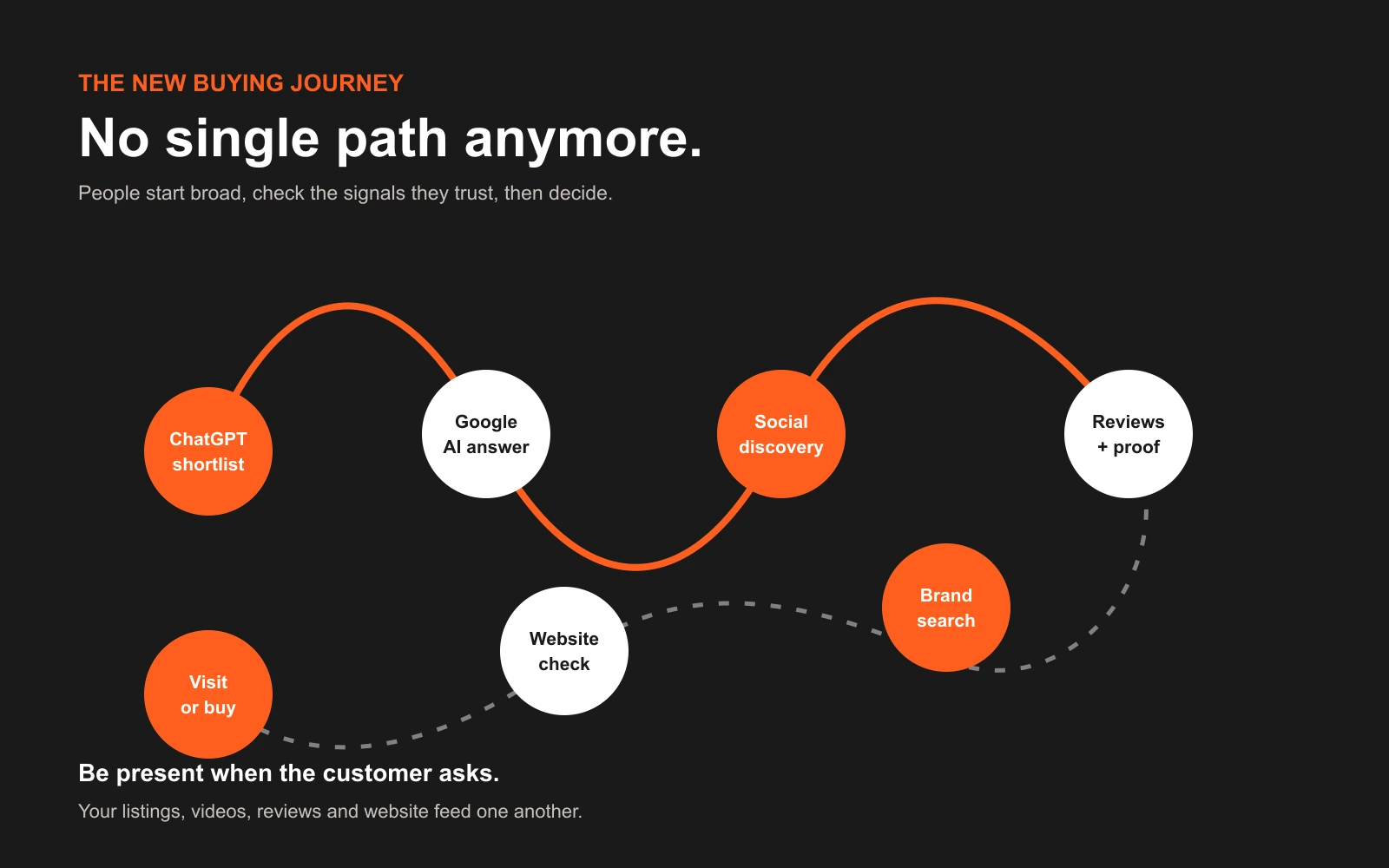
The numbers back it up. L.E.K. Consulting surveyed 2,650 consumers in April 2026: among people who use AI to shop, 46% now start their purchase research on an AI tool, against 24% on a search engine. Two years ago it was the other way around. And 94% still double-check the AI’s answer before buying, mostly on Google, reviews and the business’s own website.
AI did not replace your website or your Google presence. It added a step in front of them. The AI reads your site, your reviews and what others say about you, then hands the customer a shortlist. If you are not in the source material, you are not on the list.
To be fair, people never had just one search engine. They searched Amazon for products and Google for solutions long before AI showed up. What changed is how many starting points there are now. Younger shoppers search straight on Shopee, Lazada or Amazon. Others buy from TikTok Shop after watching a short video of someone using the product. Visual people start on Instagram or Pinterest. Plenty of people who would never shop that way live with someone who does it every week.
Most of them do not buy where they start. They begin broad and casual, scrolling and browsing, then slowly get hooked and go further down the path, narrowing the options until they buy, book, or get their answer.
These apps are search engines too. Each one has a search bar, a ranking system and a “best answer” it tries to show. The same rules win there: clear product names, honest descriptions, real photos, real reviews, a reason to trust the seller. They all feed each other. A strong brand on TikTok gets searched by name on Google. A good marketplace listing gets quoted by AI. Your website is the place all of them check when they want the full story.

Even local second-hand counts. In Singapore people check Carousell or Facebook Marketplace (Craigslist elsewhere) to see what something goes for. Then they notice the used price is almost the same as new, and they switch to a proper shop. That shop only gets the sale if it shows up on the next search.
Every one of these places is part of the same portfolio. Your listings, your videos, your reviews and your website can all be found, shared and quoted by the new platforms people use for information and advice. The goal on every channel is the same: be there when the customer asks, and be the best answer to what they asked.
This is why we track AI visibility separately for clients now, with a tool called ZeroRank, alongside Google. Two lanes, two dashboards, and the same work feeds both.
The AI summary came, wobbled, and stayed
Remember when Google’s AI summaries first showed up? In May 2024 AI Overviews rolled out in the US and went viral for the wrong reasons, like telling people to put glue on pizza. Google quietly showed them less often for a while, and plenty of people said the experiment was over.
It was not. With ChatGPT, Perplexity and Grok all answering questions directly, Google could not afford to sit it out. The summaries came back, slowly, then everywhere. People complained less each month, and now the AI answer sits at the top of the page, ads sit around it, and the classic blue links get pushed further down.
It looks like bad news for SEO, but it works the other way. Google does not sell e-bikes. It does not fix aircon or run a yoga studio. When someone asks for a product or a service, the AI answer still has to name real businesses, and it pulls those names from the sites, reviews and local signals it trusts. If you are the relevant business in that area, with clear pages that answer the question, you get named.
The goal of a search engine has not changed in 25 years: answer the question and guide the person to the best option. Yes, there is advertising around it. But the answer itself is meant to be unbiased, and good SEO is how you become the answer.
Even the SEO tools admit the old scoreboard is not enough
If you want proof that the industry agrees on this, look at what the big SEO tool companies did. Instead of declaring SEO dead, they built a second product.
Semrush launched Semrush One in late 2025 to track classic SEO and AI search side by side. Their CEO, Bill Wagner, said SEO “continues to be tablestakes”, while marketers now need new tools for AI visibility. SE Ranking, the tool that sends many of our clients their weekly reports, launched a separate AI visibility platform called SE Visible. Semrush’s own guide on AI reporting says it plainly: rankings and organic traffic measure what happens after a click, and AI answers often happen before any click at all.
When the companies that sell rank tracking tell you rank tracking alone is not the full picture, it is worth listening. The old metrics still matter. They just stopped being the whole story.
More on how that second lane works in our posts on zero-click search in Singapore and answer engine optimization.
What still wins both lanes
You do not need two strategies. The same things win in Google and in the AI answers, because both are trying to do the same job: give a person a trustworthy answer.
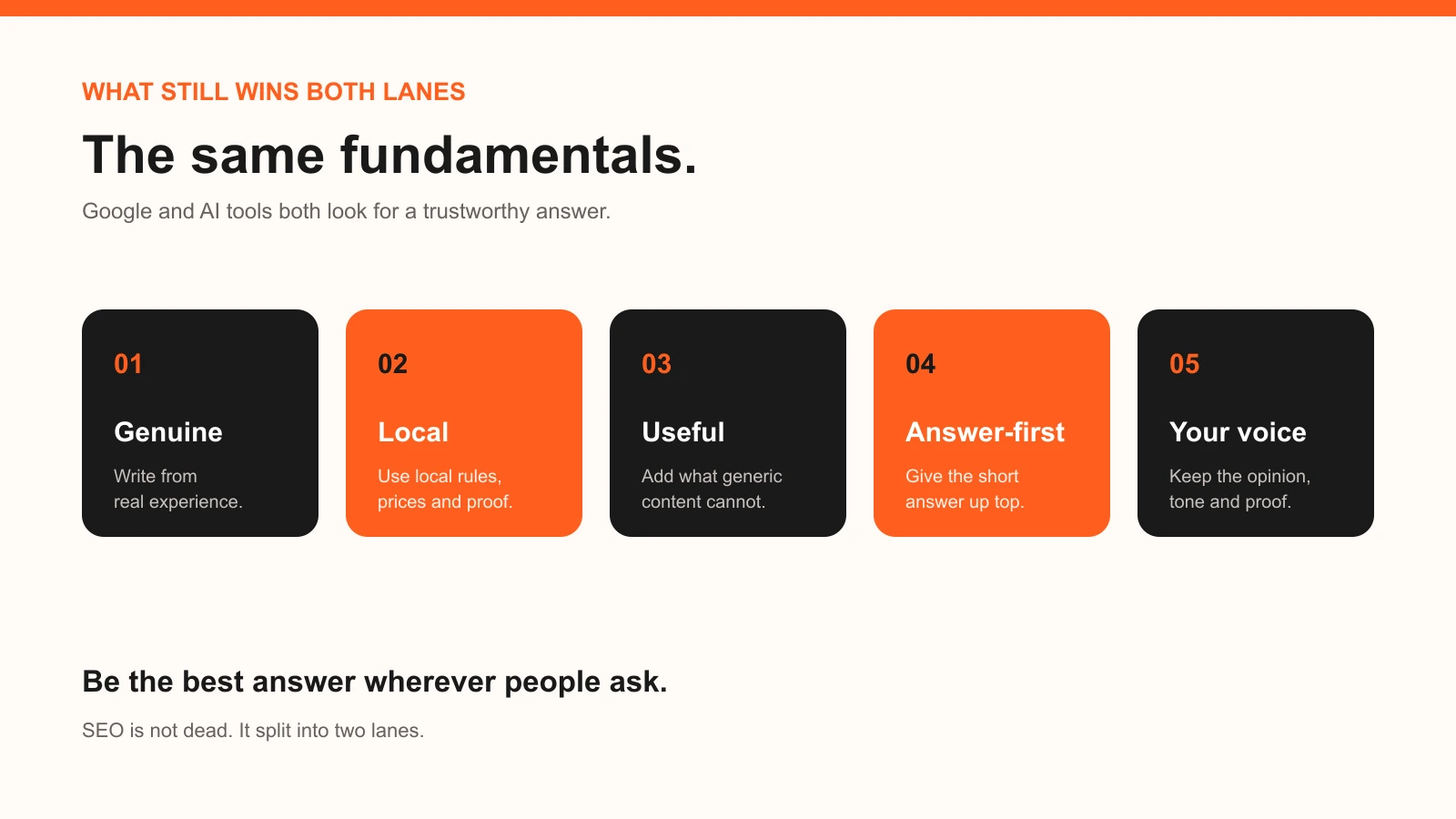
Be genuine. Write about what you actually sell and actually know. A page that ranked before on a topic you do not really cover is living on borrowed time. Google keeps getting better at noticing, and AI tools simply skip content that does not hold up.
Be local. “Best e-bike” is a global fight. “LTA approved e-bike in Singapore” is a fight you can win, and it is exactly what a local buyer and a local AI query look for. Local rules, local prices, local places, local proof.
Add value nobody else has. Information gain is the phrase SEOs use. In plain terms: what do you know from running your business that a generic article cannot say? Your real prices, your real customer questions, your test results, your photos. That is what gets quoted.
Answer first. Put a short, direct answer at the top of the page, a two or three sentence answer capsule, then explain. People skim, and AI tools lift exactly that kind of paragraph.
Keep your own voice. Your USP, your tone, a bit of personality and the reasons people trust you are what make you sound like yourself instead of everyone else in your category.
Stay in your lane. Say less, mean more
Now that every platform fights for attention, there is a temptation to publish more of everything. More posts, more pages, more topics, just to fill the space. Try everything and see what sticks.
That is the fastest way to lose authority. When a business talks about everything, it sounds like it does not really know anything. Google and the AI tools read it the same way a customer does: no clear expertise, no reason to trust it.
Our rule is simple. Keep your lane. An e-bike shop writes about e-bikes, scooters, local riding rules, maintenance and buying advice. It can go wider, into commuting, delivery work or park connectors, as long as it is related and useful to the same buyer. It does not write about crypto because the keyword had volume.
And if a post adds nothing new, do not publish it. Slop and filler only make you look busy. Better to say nothing than to say something empty.
The fundamentals of buying have not changed either. People still pick the best solution at the best price from someone they trust. Search does not change that. It only decides who gets considered.
AI or not AI is the wrong question
This is the part of the myth that annoys us most. “Google punishes AI content.” It does not, not in the way people think. Google, and people, punish content that is lazy, generic and adds nothing. AI just made lazy content cheaper to produce, so there is a lot more of it.
We use AI tools every day on client content. The difference is what goes in and who checks what comes out. Good context in: the client’s real products, real questions, real local details. Review after: a human who knows the business reads it, fixes it, adds the opinion and the proof. Used that way, AI makes the work better and faster.
Used lazily, no context, no review, no USP, no personality, it produces the cheesy, empty pages that read like every other site. Those fail with readers first, then with Google, for the same reason.
SEO researcher Lily Ray tracked more than 220 websites that AI content platforms showcased as success stories. The pattern repeated: fast publishing, a traffic climb, a peak a few months later, then a slide: 54% of those sites lost at least 30% of their peak organic traffic, 39% lost half or more, and 22% lost at least three quarters.
To be fair, that does not prove AI caused every drop. Google updates, competition and site changes all play a part. But the sites that fell had something in common: lots of interchangeable pages with little original expertise behind them.
So the problem was never the tool. It is skipping the thinking.
What we actually do when the report looks bad
No magic. We follow what is happening in search, we apply it, we monitor, we adjust.
- Check real traffic first. Is Search Console actually down, or is it one tracker having a bad week?
- Separate noise from real loss. Most drops are small keywords bouncing around. When a real money keyword drops, we find out which page Google is showing and why.
- Fix the real ones fast. Usually it is the wrong page ranking, a thin page, or two pages competing for the same term.
- Keep adding genuine content. Local, specific, answer-first, in the business’s own voice.
- Watch the AI lane too. Are you being cited, and for what?
The only channel with one clean path left is paid ads, and that gets more expensive every year. Everything else is a mix of touchpoints, and SEO is still how you show up across most of them.
Frequently Asked Questions
Is SEO still worth it in 2026?
Yes. Search is still where most buying research ends up, even when it starts in ChatGPT. 94% of AI-assisted shoppers double-check on Google, reviews or the business website before buying. A business that stops doing SEO stops showing up in both Google and the AI answers.
Why do my rankings change so much every week?
Google’s May 2026 core update made rankings far more volatile, and they stayed that way. A study of 8.1 million searches found 48.7% more volatility. Weekly swings of 10 or 20 positions on smaller keywords are normal now. Judge SEO on the trend over weeks and on Search Console data, not on single-day positions.
Does Google penalise AI-written content?
Not for being AI. Google targets content that is unhelpful, generic or mass-produced. AI content with real context, human review and genuine expertise performs fine. AI content published without review, value or a point of view tends to fail, with readers and with Google.
What is the difference between SEO and AEO?
SEO gets you ranked in Google’s classic results. AEO (answer engine optimization) gets you cited inside AI answers like Google AI Overviews and ChatGPT. In practice the same work drives both: clear answers, local detail, real proof and a well-structured site.
The verdict
SEO is not dead. It split into two lanes, it got louder, and the scoreboard moves daily. None of that changes what wins. Genuine, local, useful content, written in your own voice and checked by someone who knows the business, works for people, works for Google and works for the AI tools reading both.
Ignore the weekly funeral. Keep doing the real work.
Want SEO that covers both lanes, with reports that tell you the truth on bad weeks too? Reach out at [email protected].
Reviewed and fact-checked by Bobby Dennie, Rezult. [email protected]